Legacy CS 1.3: validation findings
Windows verification of music, baked stickers and HUD assets, plus Legacy 1.3 matchmaking rules.
Verified November 9, 2026 against an isolated Windows 11 VM and a native protocol-45 CS 1.3 server.
Actual Legacy 1.3
Legacy 1.3 runs the real CS 1.3 game. The discontinued CS 1.6 legacy emulation queues are retired. Their manual bunny-hop and weapon rules remain available through the default-off Legacy Mode checkbox in CS 1.6 custom games, with a help tooltip.
There is one Legacy 1.3 queue. Match Found requires at least two humans. Accepted players enter warmup; all connected non-AFK humans can vote /startearly. Automatic start keeps the existing seven-minute threshold halving, with a two-human floor: off-peak 3 → 2, peak 6 → 3 → 2.
The separate 1v1 queue is removed. Warmup selects the final size from its active population:
| Humans | Match | Bots | Regulation |
|---|---|---|---|
| 2 | 1v1 | 0 | MR8 |
| 3–4 | 2v2 | 1 / 0 | MR8 |
| 5–6 | 3v3 | 1 / 0 | MR12 |
| 7–8 | 4v4 | 1 / 0 | MR12 |
| 9–10 | 5v5 | 1 / 0 | MR12 |
For odd populations, the bot accompanies a highest-MMR human. Parties remain together; if a party cannot fit the current size, warmup waits for more humans. The backend commits the roster, and the game server rejects stale acknowledgements. AFK players do not block the vote.
Music: measured Windows playback
The test client reported Half-Life 1.0.1.4, protocol 45, hardware build 2006. It used Mesa llvmpipe inside the VM; this was a compatibility test, not a performance benchmark.
The authenticated player selected the expected music kit. A disposable controller invoked the existing first-blood and MVP playback functions. VM-only audio captures matched their source WAVs:
| Clip | Normalized correlation |
|---|---|
| Quake first blood | 0.997 |
| Quake MVP | 0.998 |
| Complete 24.059-second custom MVP | 0.99734 |
The long clip was mono 16-bit PCM at 22050 Hz and played after a map reload. The test also exercised a bot music pool entry. The custom-game startup failure was caused by treating BOT_MUSIC_0 as a human authentication token; those identifiers now remain separate.
These results verify kit selection and server-delivered WAV playback. They do not cover actual kill/award event triggering in the Windows test, MP3, every audio format, or the complete purchase/equip/download interface.
Stickers: ordinary precached models
CS 1.3 uses the backend-authorized sticker recipe to bake a GoldSrc v10 first-person model before freezing the match loadout. It uses ordinary engine model loading and precache, without adding a native sticker hook.
The baker verifies model and artwork hashes, bounds its worker queue and execution time, and writes an immutable model. Regions obtain its full SHA-256 through the trusted asset manifest. Generated paths stay below the old engine's 64-character path limit. Failed optional bakes retain the ordinary weapon skin.
Stock held and dropped models stay native to CS 1.3. Custom skins retain their existing held/dropped companions. Stickers affect first-person appearance; they do not grant ownership to another account.
A visibly distinct magenta/cyan test sticker rendered on an AK-47 in the Windows client. CS 1.3 uses indexed palette textures, so its sticker fidelity differs from CS 1.6's high-resolution native overlays. The result does not establish compatibility with every weapon, custom model, graphics driver or resource-table load.
Broken HUD icons: cause and fix
The initial VM fixture omitted sprites/hud.txt and the weapon sprite definitions. The engine displayed incorrect sprite regions for health, ammo and radar. The sprite image hashes matched the native CS 1.3 distribution; adding the matching definition files fixed the HUD after restart.
The launcher already preserves these .txt resources when preparing its match folder. A regression check now explicitly covers hud.txt and weapon_ak47.txt. This was incomplete test-fixture data, not a sticker texture failure. Player configuration was not accessed or modified by the tooling.
Crosshair and Tab scoreboard
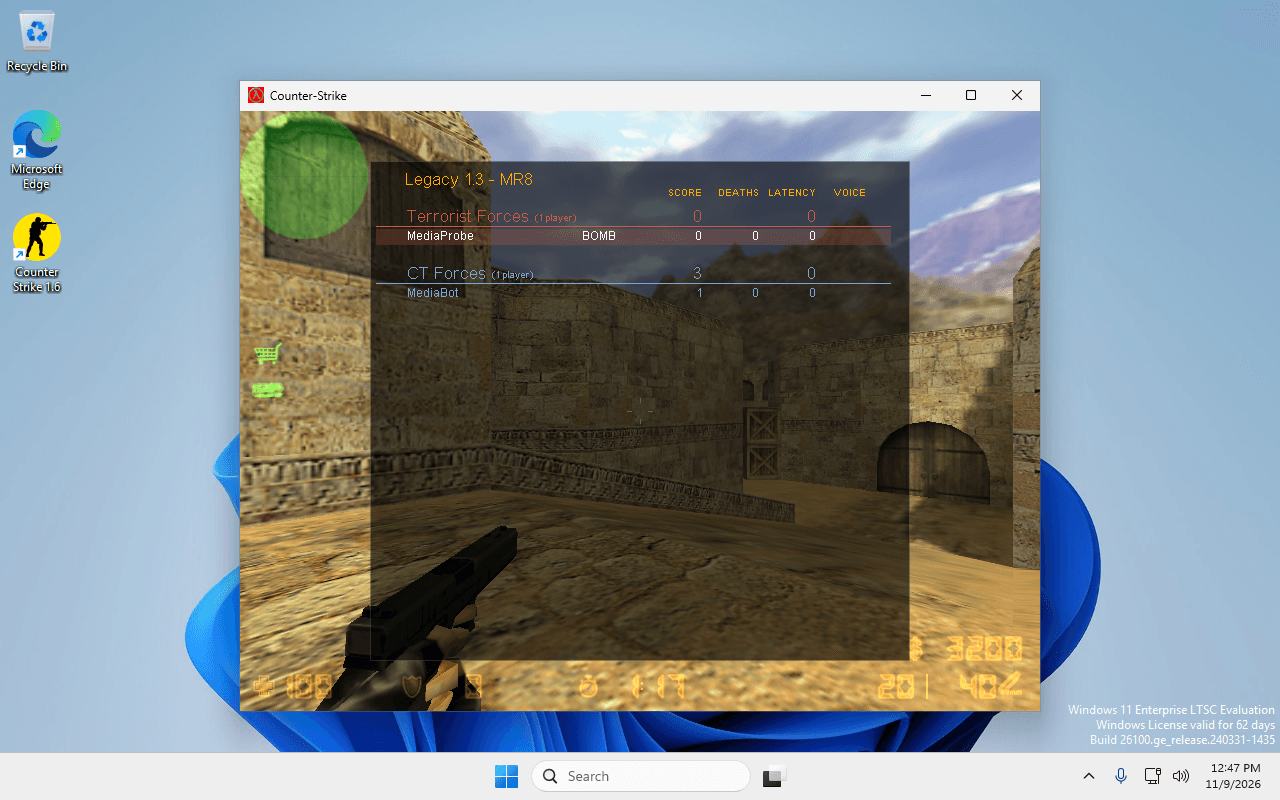
The stock crosshair is visible on the tested AGC client, and holding Tab opens its native scoreboard. The same incomplete fixture also lacked titles.txt and the Valve VGUI text schemes; these resources belong to the original installation and are separate from the HUD sprite definitions. Restoring them fixed the scoreboard labels and column alignment; names, teams, score, deaths and latency rendered correctly.
The custom crosshair and scoreboard module has a stricter legacy compatibility gate. It recognizes the inspected WON executable SHA-256 525c1a32a520bbde8857e8dc3ed1e5bbc8b2ef5620bc6cdbcdbc72c34542bace. The tested AGC executable is b5f34ed4726d93a9c3d4b3d3eb60df5680f5ae888710f5461e54a462e1efd487, so it keeps the stock HUD. Prior Wine rendering tests on the approved WON build do not establish native Windows support for this AGC executable. This release does not broaden that native-module compatibility gate.
Other fixes in this release
Custom-room settings no longer depend on the matchmaking WebSocket being connected. Existing map/mode selections remain saveable while the catalog is unavailable. Save operations show pending and completion feedback, and Legacy Mode has an explanatory tooltip.
Sessions authenticated through partner login hide the username and password changers in Settings. Ordinary account login remains available as before.
Verification boundaries
Native server tests cover warmup votes, automatic thresholds, AFK exclusion, stale roster acknowledgements, bot retirement and round limits for 2, 3, 5 and 10 humans. Separate tests cover invalid recipes, corrupt artwork, immutable output hashes, native companion preservation and authenticated bake requests. Windows observations are evidence for the specific host above, not a claim of universal GoldSrc compatibility or anti-cheat approval.